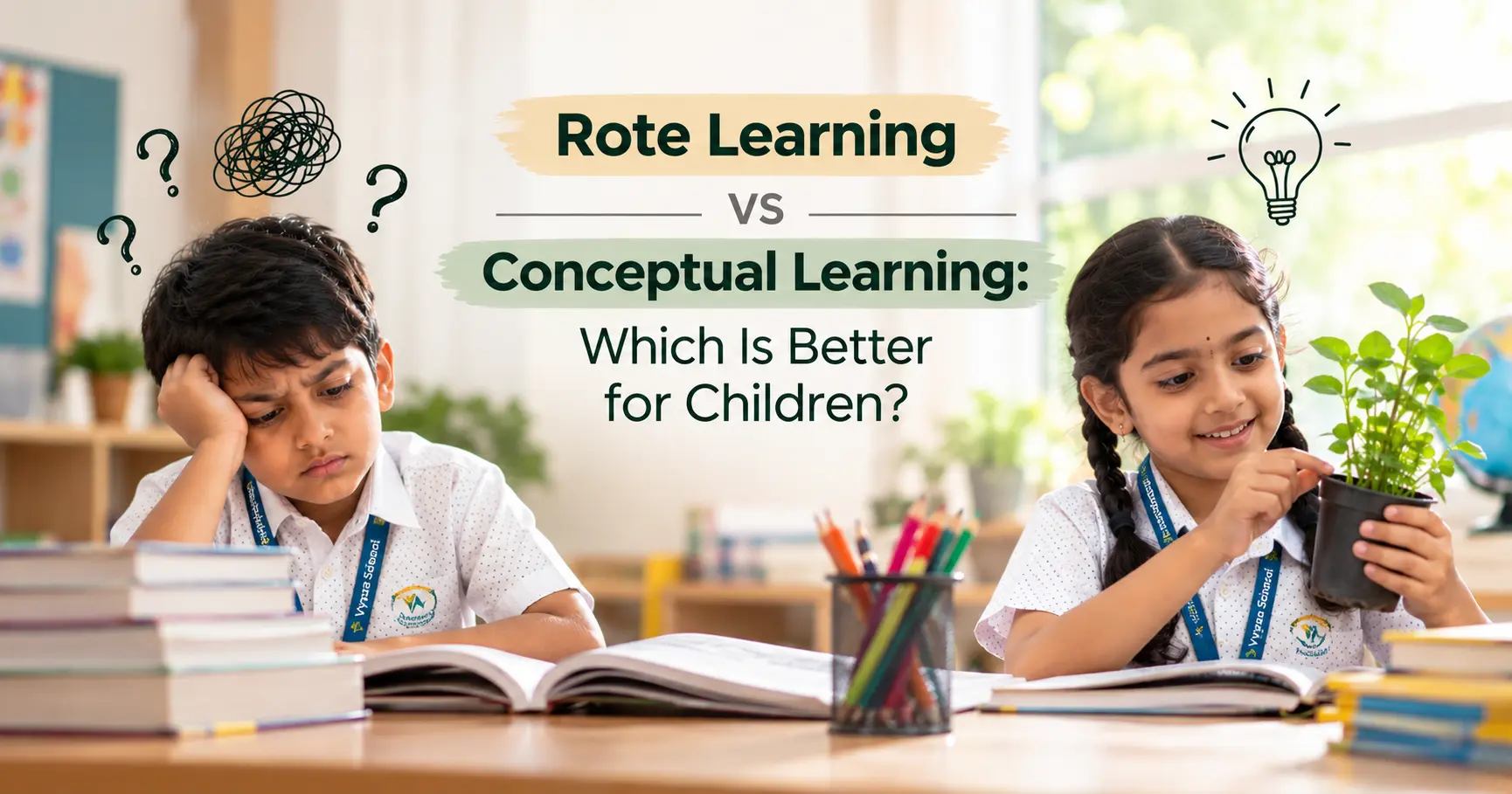
Rote Learning vs Conceptual Learning: Which Is Better for Children?
Discover how Vvyasa School, one of the best CBSE schools in Hyderabad, encourages conceptual learning, critical thinking, and academic excellence in children.
Education goes beyond memorizing information and achieving high grades; it fosters comprehension, curiosity, and the ability to implement knowledge in real life. When looking for the best CBSE schools in Hyderabad, parents strive to discover places which focus on meaningful and enjoyable learning instead of practicing rote memorization.
Rote learning and conceptual learning are two types of education. Although both are necessary for the process of education, recognizing their characteristics helps parents to figure out which type is better for their children in the classroom.
What Is Rote Learning?
Rote learning refers to a learning technique whereby students learn information through repeating it. This is largely used in constantly memorising certain mathematical tables, paradigms, formulas, and so on. For instance, a student can know a definition of a science term and write it down in an exam without knowing what it means.
Advantages of rote learning:
-
It helps students keep some useful facts and pieces of information in their heads.
-
It assists students in learning simple knowledge, for example. multiplication tables and vocabulary.
-
It can be helpful in preparing for particular exams.
-
It lets people learn necessary definitions and formulas.
On the other hand, using only memorization for learning purposes may blur the ability of children to understand challenging topics. Students may have difficulties answering questions which are presented to them not in the exact way they have learnt it. Furthermore, even if a person repeats something by heart, he/she may often apply this knowledge in a wrong way in unusual situations.
What Is Conceptual Learning?
Conceptual learning focuses on understanding the meaning behind information. Instead of simply memorising facts, students explore why something happens, how different ideas connect, and how knowledge can be applied to practical situations.
For example, rather than memorising a mathematical formula, a student learns why it works and when to use it. Similarly, in science, students understand a concept through demonstrations, experiments, observations, and discussions.
This approach is an important consideration for parents evaluating the best CBSE schools in Hyderabad, particularly when looking for an education that encourages independent thinking.
Advantages of conceptual learning:
-
Develops critical thinking and problem-solving abilities.
-
Encourages curiosity and active participation.
-
Helps students connect classroom lessons with real-life situations.
-
Improves understanding and long-term retention.
-
Builds confidence in tackling unfamiliar questions.
Conceptual learning also encourages students to ask questions, express their ideas, and learn from mistakes. These experiences can make education more engaging and meaningful.
Rote Learning vs Conceptual Learning: Key Differences
Although both methods can support education, they differ in their primary objectives.
1. Learning Methodology
Rote learning relies on repetition and memorization, while conceptual learning puts emphasis on beliefs and principles of understanding.
2. Usage of Knowledge
Students who are more dependent on the process of memorization are likely to have difficulty with taking care of unusual problems. Conceptual learners are much better able to use knowledge in various scenarios.
3. Involvement of Students
Rote learning consists mainly of reading and memorizing. Conceptual learning is usually conducted via discussions, actions, experiments, etc.
4. Lasting Knowledge Acquisition
Memorized facts can be forgotten in time, while understanding of concepts can help students memorize things better.
5. Test Preparation
Memorization allows students recall vital information, while understanding of concepts provides management of analytical questions and problem-solving tasks.
Both approaches can be useful when applied appropriately. The goal is to ensure that memorisation supports understanding rather than replacing it.
Why Conceptual Learning Matters in CBSE Education
According to the CBSE curriculum, it contains fundamental subjects and learning objectives for students that will help children to learn and develop understanding and thinking. Conceptual learning helps students with these objectives since it provides basic insights about the things they learn.
When searching for the best CBSE schools in Hyderabad, parents should check different ways of how teachers can teach complicated subjects, stimulate students’ participation, and connect study with life.
Diverse practical activities, group projects, visual learning materials, and discussions in the classroom will help children to learn the concepts better. For example, it is possible to explain fractions with the help of regular objects and use simple experiments for explaining scientific concepts.
This kind of experience can also help children to be more self-confident and self-reliant in their studies.
How Parents Can Encourage Conceptual Learning at Home
The role of parents is crucial in making the learning processes of children easier. Parents need to make small adjustments in their daily routine to improve their child's learning experience.
-
Encourage questioning: Allow children to ask why and how instead of forcing them to memorise all answers.
-
Provide real-life examples: Use shopping, cooking or other day-to-day activities to illustrate mathematical concepts.
-
Emphasise comprehension: The child should be willing to explain what he/she has learned.
-
Make learning engaging: Educational games, puzzles, experiments and discussions should be part of the learning processes.
-
Appreciate children’s efforts: Value curiosity, improvement and problem-solving as opposed to focusing on grades only.
Which Learning Method Is Better for Children?
Conceptual learning might be the better method to use for promotion of deep understanding, critical thinking and the ability to apply one's knowledge. However, rote learning proves to be very useful when it comes to memorization of basic facts, terms, words and formulas.
The best method combines both methods. This way, a student is capable of memorizing important information and understanding how exactly it works. Such an approach will ensure progress without relying entirely on repetition.
While choosing the best CBSE schools in Hyderabad, parents should not concentrate only on examination results, but also on how the school can help children in terms of acquiring knowledge, creativity, confidence and independent thinking.
Conclusion
Rote learning is different from conceptual learning. Rote learning only encourages children to remember things, while conceptual learning provides real understanding of what has been learned. While memorizing more easily allows for recollection, understanding helps students in various circumstances.
At Vvyasa School, the idea of giving meaning to learning, encouraging students’ curiosity, and developing them is all in line with the idea of connecting new learning with old ones.
FAQs
1. What is the difference between rote learning and conceptual learning?
Rote learning focuses on memorising information through repetition, while conceptual learning helps students understand ideas and apply their knowledge in real-life situations.
2. Which learning method is better for children?
Conceptual learning is generally better for developing critical thinking and problem-solving skills. However, combining it with memorisation helps children remember essential facts and formulas.
3. Why is conceptual learning important in CBSE education?
Conceptual learning helps students understand subjects deeply, improve analytical skills, and apply their knowledge to different types of questions and practical situations.
4. How can parents encourage conceptual learning at home?
Parents can encourage children to ask questions, use real-life examples, participate in educational activities, and explain lessons in their own words.
5. How can parents choose the right CBSE school in Hyderabad?
Parents should consider teaching methods, academic support, practical learning opportunities, facilities, and overall child development when choosing among the best CBSE schools in Hyderabad.
Comments 0
No comments yet. Share a thought below — it appears after the school reviews it.