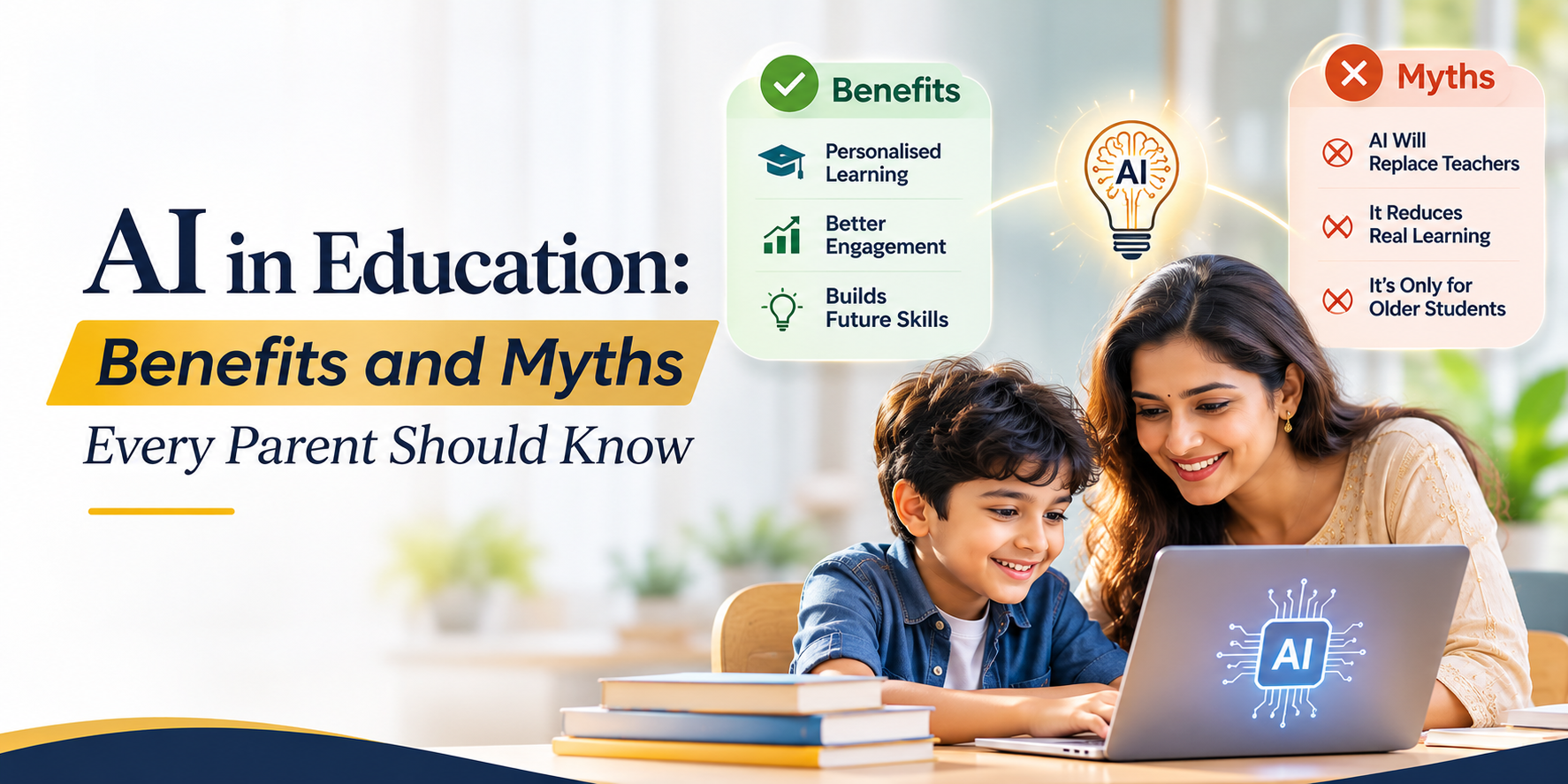
AI in Education: Benefits and Myths Every Parent Should Know
Learn how AI is transforming education, its benefits and common myths, and how Vvyasa School, Bowrampet, encourages balanced learning and technology use.
AI or Artificial Intelligence is playing an increasing role in the modern education system. There are learning systems tailored for each student, and also interactive teaching systems changing the way students learn.
With the introduction of AI systems, parents have to wonder about the effect of these technologies on their children's education. Do those systems make it easier for kids to learn or create a dependency on technology?
Getting familiar with the pros and cons of the technology would help parents make their decisions when they are looking for the best CBSE schools in Bachupally.
What Is AI in Education?
Education with AI means the use of smart software and technology tools to make the learning experience easier for everyone involved. These tools can assess students’ answers to their questions, find learning gaps, and give students additional study opportunities based on their needs.
The most popular and common varieties of educational tools are:
-
AI-based learning mobile apps.
-
Digital tests and quizzes.
-
Personalized learning platforms.
-
Educational interactive games.
-
Language learning support tools and language writing aids.
-
Virtual learning assistants.
AI aims to assist the educator and the learning process. It should not replace the teacher, engagement in the class, or the student’s own thinking.
5 Benefits of AI in Education
1. Personalised Learning Experience
Each child has a different learning style. While some learners demonstrate a quick grasp of information, others require many explanations and much practice before they succeed at a task.
By employing artificial intelligence in learning, such platforms can easily change their questions as well as activities depending on students' progress. Children are free to study at their own pace and focus on problem areas.
2. Better Understanding of Difficult Concepts
Some fields of study, particularly Mathematics and Science, can be difficult for some students. This is where AI-supported educational tools come in as they provide information, illustrations, and exercises aimed to simplify hard topics.
Nevertheless, students should also work on their own when it comes to solving problems without relying on answers from digital sources.
3. Instant Feedback and Practice
Digital learning tools can give instant feedback on quizzes and practice activities. Students are able to know their mistakes, find out the areas that need to be improved upon and can practice the similar questions.
This promotes continuous education rather than waiting for exams to recognize the lack of knowledge.
4. Encourages Curiosity and Exploration
AI technology is capable of taking children beyond the boundaries of textbooks. This means that learners can now access new subjects, understand scientific questions and come up with creative solutions.
Therefore, the children who work with such tools are able to maintain their interest in learning and learn to explore things on their own.
5. Supports Teachers in the Classroom
Artificial intelligence can assist educators in developing lesson plans and arranging tests, and finding out what the undereducated students are struggling with.
This will help educators spend more time interacting with students in the classroom, giving them personal attention and creating a good learning experience for them.
Common Myths About AI in Education
Although AI offers several benefits, many parents have concerns about its impact on children's learning. Understanding these common myths can help families use technology responsibly.
Myth 1: AI Will Replace Teachers
Fact: AI cannot replace the emotional understanding, guidance and personal connection that teachers provide. Teachers understand students' behaviour, encourage participation and support their individual development. AI is a tool that can assist teachers, not replace them.
Myth 2: Children Can Learn Everything Through AI
Fact: Education involves much more than accessing information. Children need classroom discussions, practical activities, teamwork, communication and real-world experiences. AI can support learning, but it cannot provide every aspect of a child's educational development.
Myth 3: Using AI Automatically Improves Academic Performance
Fact: Technology alone does not guarantee better results. Students must actively participate, practise regularly and understand the concepts they are learning. AI is most useful when combined with proper teaching and consistent effort.
Myth 4: AI Makes Children Less Creative
Fact: The impact depends on how children use it. If students simply copy AI-generated answers, their independent thinking may suffer. However, using AI to explore ideas, ask questions and experiment with different approaches can support creativity.
Myth 5: AI Is Only Useful for Older Students
Fact: Age-appropriate digital learning tools can support younger children through interactive activities and educational games. However, screen time, content and usage should always be guided by parents and teachers.
How Can Parents Encourage Responsible AI Usage?
Parents play an important role in helping children understand how to use technology safely and effectively.
Here are some practical suggestions:
-
Set clear screen-time limits: Balance digital learning with outdoor play, reading and other activities.
-
Encourage independent thinking: Ask children to understand and explain answers instead of simply copying them.
-
Choose age-appropriate tools: Select educational applications that match the child's age and learning level.
-
Discuss online safety: Teach children not to share personal information with digital platforms.
-
Stay involved: Understand which tools children are using and how they support their studies.
-
Promote creativity: Encourage children to use technology for exploring ideas rather than depending on ready-made answers.
Parents comparing CBSE schools in Bowrampet should also understand how schools introduce digital learning while maintaining a strong focus on classroom teaching and student interaction.
What Should Parents Look for in a Technology-Enabled School?
A good educational environment should use technology thoughtfully without allowing it to dominate the learning experience.
When evaluating top schools near Dundigal, parents can consider the following:
-
Balanced Teaching Methods: Technology should complement classroom teaching and practical activities.
-
Teacher Guidance: Teachers should help students understand when and how to use digital tools.
-
Practical Learning: Students should have opportunities to participate in experiments, projects and group activities.
-
Digital Awareness: Schools should encourage responsible technology usage and online safety.
-
Overall Development: Education should include sports, arts, communication and social interaction alongside academics.
The best CBSE schools in Bachupally should focus not only on digital facilities but also on developing confident, responsible and independent learners.
How Vvyasa School Supports Holistic Learning
Vvyasa School in Bowrampet aims to deliver education that builds strong foundations of learning as well as promotes the development of children's interests. The school adopts the CBSE curriculum and maintains a constructive learning environment for students.
Spread over 5 acres of land, the school has well-equipped maths labs, science labs, robotics labs and computer labs, in addition to providing opportunities in an array of activities such as music, dance, yoga, karate and skating.
Vvyasa School helps children learn academic subjects and gain skills essential for the future through excellent academic, practical and extracurricular education.
Conclusion
The advancement of AI creates many possibilities in the field of education but we think technology should facilitate the learning process, rather than interfering with it. Therefore, at Vvyasa School we do not encourage our students to rely too much on AI devices or spend too long using their computers and mobile phones. In our opinion, children learn the easiest and the best when they are guided by a teacher, communicate with their fellow students in the classroom and practice what they learn. We use technology intelligently and balance its use with traditional means of education.
FAQs
1. What are the benefits of AI in education for school students?
AI can support personalised learning, provide instant feedback, offer additional practice and help students explore difficult concepts through interactive educational tools.
2. Can AI replace teachers in schools?
No. AI can assist teachers with learning resources and assessments, but it cannot replace their guidance, emotional support, classroom interaction and understanding of individual students.
3. Is AI safe for school children?
AI can be used responsibly when children access age-appropriate tools under parental and teacher supervision. Screen-time limits and online safety awareness are also important.
4. How can parents help children use AI for learning?
Parents can encourage children to use AI for explanations, practice and exploring ideas while ensuring they complete assignments independently and understand the answers.
5. Should parents consider technology facilities when choosing a CBSE school?
Yes, but technology should be considered alongside teaching quality, academic support, practical learning, extracurricular activities, student safety and overall development.
Comments 0
No comments yet. Share a thought below — it appears after the school reviews it.